
🗂️ Collection#
#bs.collection:help
Functional programming operations for working with collections in Minecraft. This module is NOT a stream module, features are not lazy.
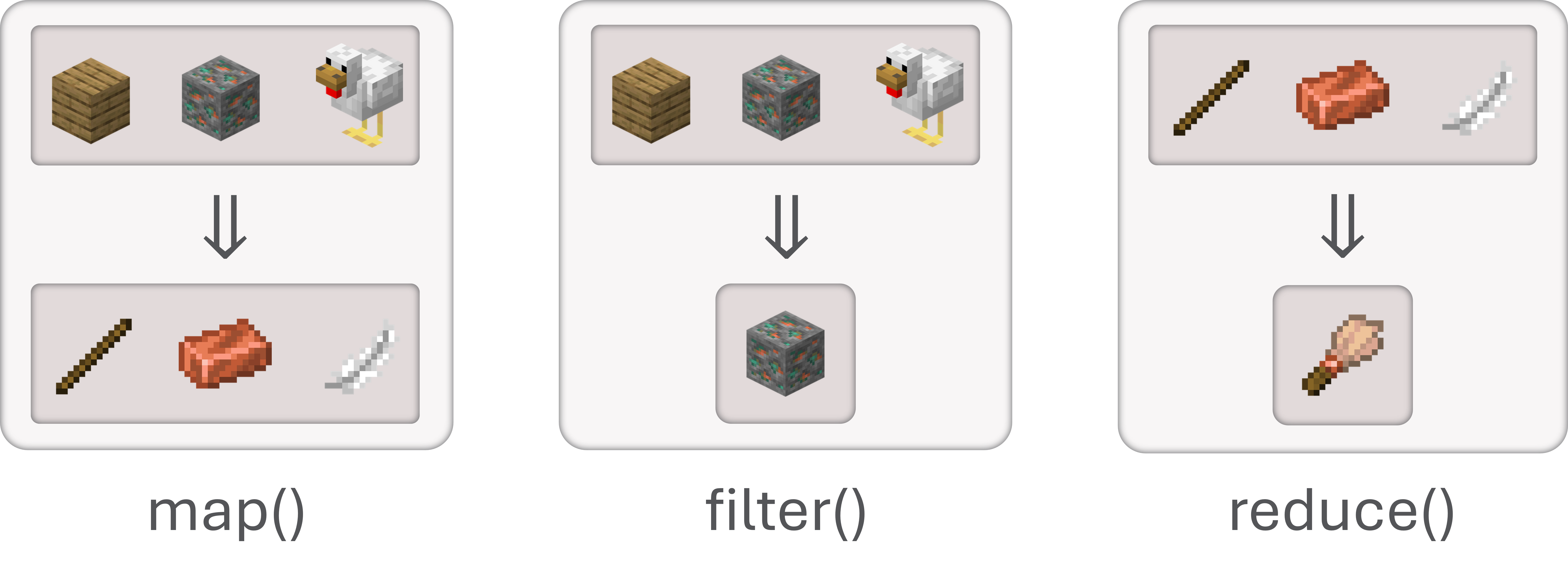
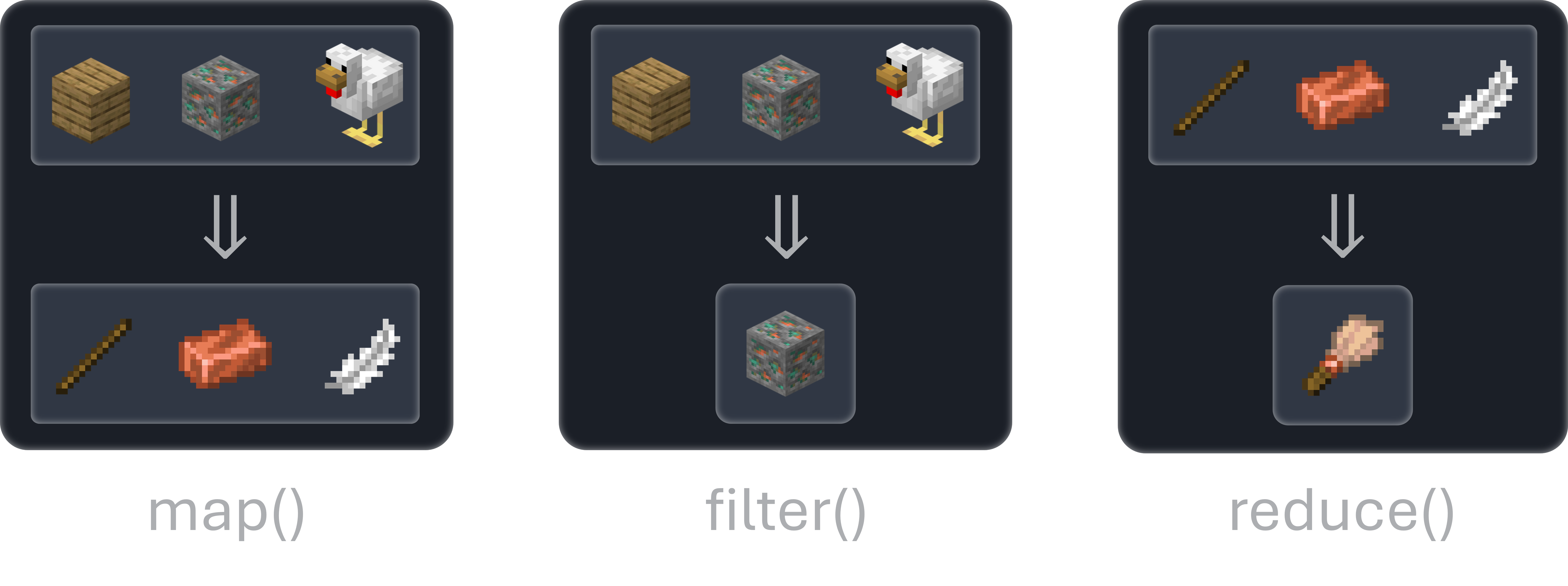
“It is better to have 100 functions operate on one data structure than 10 functions on 10 data structures.”
—Alan Perlis
🔧 Functions#
You can find below all functions available in this module.
Input and Output
Unlike most Bookshelf modules, collection features typically read their input from bs:out instead of bs:in.
This design facilitates operation chaining, as the output of one function immediately becomes the input for the next.
Drop#
Operations that remove elements from the start of a collection.
- #bs.collection:drop {number:<value>}
Drop the first N elements from a collection.
- Inputs:
Storage
bs:out collection.value: the collection to drop fromFunction macro:
arguments
number: the number of elements to drop
- Outputs:
Storage
bs:out collection.value: the collection with the first N elements removed
Example: drop first 2 elements
data modify storage bs:out collection.value set value [1, 2, 3, 4, 5]
function #bs.collection:drop {number: 2}
# bs:out collection.value = [3, 4, 5]
Credits: theogiraudet
- #bs.collection:drop_while {run:<value>}
Drop elements from the beginning of a collection as long as a predicate is true.
- Inputs:
Storage
bs:out collection.value: the collection to drop fromFunction macro:
arguments
run: predicate function
- Outputs:
Storage
bs:out collection.value: the remaining elements- Lambdas:
Storage
bs:lambda collection:lambda data
value: the current element being processed
index: the zero-based index of the current element
Return: success (1) to continue dropping, fail (0) otherwise
Example: drop elements until value is 3
data modify storage bs:out collection.value set value [1, 2, 3, 4, 5]
function #bs.collection:drop_while {run: "execute unless data storage bs:lambda {collection: {value: 3}}"}
# bs:out collection.value = [3, 4, 5]
Credits: theogiraudet
Filtering#
Operations that select a subset of elements.
- #bs.collection:distinct
Remove duplicate elements from a collection, keeping only the first occurrence of each element.
- Inputs:
Storage
bs:out collection.value: the collection to process- Outputs:
Storage
bs:out collection.value: the collection with duplicates removed
Example: remove duplicates
data modify storage bs:out collection.value set value [1, 2, 2, 3, 1]
function #bs.collection:distinct
# bs:out collection.value = [1, 2, 3]
Credits: theogiraudet
- #bs.collection:filter {run:<value>}
Keep only elements that satisfy a predicate condition.
- Inputs:
Storage
bs:out collection.value: the collection to filterFunction macro:
arguments
run: predicate function to test each element
- Outputs:
Storage
bs:out collection.value: the filtered collection containing only matching elements- Lambdas:
Storage
bs:lambda collection:lambda data
value: the current element being processed
index: the zero-based index of the current element
Return: success (1) to keep the element, fail (0) otherwise
Example: keep only elements equal to 3
data modify storage bs:out collection.value set value [1, 3, 2, 3, 4]
function #bs.collection:filter {run: "execute if data storage bs:lambda collection{value: 3}"}
# bs:out collection.value = [3, 3]
Credits: theogiraudet
Find#
Operations that locate elements or their indices.
- #bs.collection:find {run:<value>}
Find the first element that satisfies a predicate condition.
- Inputs:
Storage
bs:out collection.value: the collection to searchFunction macro:
arguments
run: predicate function
- Outputs:
Storage
bs:out collection:output data
value: the first matching element (removed if not found)
index: the index of the matching element, or -1 if not found
Return: success if element found, fail otherwise
- Lambdas:
Storage
bs:lambda collection:lambda data
value: the current element being processed
index: the zero-based index of the current element
Return: success (1) for match, fail (0) otherwise
Example: find the first element equal to “b”
data modify storage bs:out collection.value set value ["a", "b", "c"]
function #bs.collection:find {run: "execute if data storage bs:lambda collection{value: 'b'}"}
# bs:out collection.value = "b"
# bs:out collection.index = 1
Credits: theogiraudet
- #bs.collection:find_last {run:<value>}
Find the last element that satisfies a predicate condition.
- Inputs:
Storage
bs:out collection.value: the collection to searchFunction macro:
arguments
run: predicate function
- Outputs:
Storage
bs:out collection:output data
value: the last matching element (removed if not found)
index: the index of the matching element, or -1 if not found
Return: success if element found, fail otherwise
- Lambdas:
Storage
bs:lambda collection:lambda data
value: the current element being processed
index: the zero-based index of the current element
Return: success (1) for match, fail (0) otherwise
Example: find the last element equal to 3
data modify storage bs:out collection.value set value [1, 2, 3, 4, 3, 5]
function #bs.collection:find_last {run: "execute if data storage bs:lambda collection{value: 3}"}
# bs:out collection.value = 3
# bs:out collection.index = 4
Credits: theogiraudet
- #bs.collection:index_of {run:<value>}
Find the index of the first element matching a predicate.
- Inputs:
Storage
bs:out collection.value: the collection to searchFunction macro:
arguments
run: predicate function
- Outputs:
Storage
bs:out collection.value: the zero-based index of the first matching element, or -1Return: success if element found, fail otherwise
- Lambdas:
Storage
bs:lambda collection:lambda data
value: the current element being processed
index: the zero-based index of the current element
Return: success (1) for match, fail (0) otherwise
Example: find the index of value 3
data modify storage bs:out collection.value set value [1, 2, 3, 4, 3, 5]
function #bs.collection:index_of {run: "execute if data storage bs:lambda collection{value: 3}"}
# bs:out collection.value = 2
Credits: theogiraudet
- #bs.collection:last_index_of {run:<value>}
Find the index of the last element matching a predicate.
- Inputs:
Storage
bs:out collection.value: the collection to searchFunction macro:
arguments
run: predicate function
- Outputs:
Storage
bs:out collection.value: the zero-based index of the last matching element, or -1Return: success if element found, fail otherwise
- Lambdas:
Storage
bs:lambda collection:lambda data
value: the current element being processed
index: the zero-based index of the current element
Return: success (1) for match, fail (0) otherwise
Example: find the last index of value 3
data modify storage bs:out collection.value set value [1, 2, 3, 4, 3, 5]
function #bs.collection:last_index_of {run: "execute if data storage bs:lambda collection{value: 3}"}
# bs:out collection.value = 4
Credits: theogiraudet
Flattening#
Operations that flatten nested collections.
- #bs.collection:concat
Concatenate a list of lists into a single list. Functionally equivalent to
flatten, provided as a semantic alias for when you think of the operation as concatenation rather than flattening.- Inputs:
Storage
bs:out collection.value: a list of lists to concatenate- Outputs:
Storage
bs:out collection.value: the flattened list containing all elements from the sub-lists in order
Example: concatenate lists
data modify storage bs:out collection.value set value [[1, 2], [3], [4, 5]]
function #bs.collection:concat
# bs:out collection.value = [1, 2, 3, 4, 5]
Credits: theogiraudet
- #bs.collection:flatten
Flatten a nested collection by one level.
- Inputs:
Storage
bs:out collection.value: the nested collection to flatten- Outputs:
Storage
bs:out collection.value: the flattened collection
Example: flatten a 2D array
data modify storage bs:out collection.value set value [[1, 2], [3, 4], [5]]
function #bs.collection:flatten
# bs:out collection.value = [1, 2, 3, 4, 5]
Credits: theogiraudet
- #bs.collection:flatten_deep
Recursively flatten a nested collection of arbitrary depth. Preserves non-list elements.
- Inputs:
Storage
bs:out collection.value: the nested collection to flatten- Outputs:
Storage
bs:out collection.value: the deeply flattened collection
Example: flatten a deeply nested structure
data modify storage bs:out collection.value set value [1, [2, 3], [[4], 5]]
function #bs.collection:flatten_deep
# bs:out collection.value = [1, 2, 3, 4, 5]
Credits: theogiraudet
Fold#
Reduce a collection to a single value using an explicit initial accumulator.
- #bs.collection:fold {run:<value>,initial:<value>}
Reduce a collection to a single value by applying a function that combines the accumulator with each element, starting with a provided initial value.
- Inputs:
Storage
bs:out collection.value: the collection to foldFunction macro:
arguments
run: lambda function that combines accumulator and value
initial: initial value for the accumulator, must be a valid NBT value
- Outputs:
Storage
bs:out collection.value: the final accumulated valueReturn: 0 on success
- Lambdas:
Storage
bs:lambda collection:lambda data
accumulator: (input) the current accumulated value
value: (input) the current element being processed
index: (input) the zero-based index of the current element
result: (output) the new accumulated value
Example: fold with a custom function (see reduce for lambda details)
data modify storage bs:out collection.value set value [1, 2, 3]
function #bs.collection:fold {run: "data modify storage bs:lambda collection.result set from storage bs:lambda collection.value", initial: 0}
# bs:out collection.value = 3 (last element replaces accumulator each time)
Credits: theogiraudet
- #bs.collection:fold_right {run:<value>,initial:<value>}
Reduce a collection to a single value by applying a function from right to left with a provided initial value.
- Inputs:
Storage
bs:out collection.value: the collection to foldFunction macro:
arguments
run: lambda function that combines accumulator and value
initial: initial value for the accumulator, must be a valid NBT value
- Outputs:
Storage
bs:out collection.value: the final accumulated valueReturn: 0 on success
- Lambdas:
Storage
bs:lambda collection:lambda data
accumulator: (input) the current accumulated value
value: (input) the current element being processed
index: (input) the zero-based index of the current element
result: (output) the new accumulated value
Credits: theogiraudet
Generation#
Operations that create new collections.
- #bs.collection:generate {run:<value>,limit:<value>}
Generate a collection by repeatedly calling a generator function up to a limit.
- Inputs:
Function macro:
arguments
run: the command to execute to generate a value
limit: the number of values to generate
- Outputs:
Storage
bs:out collection.value: the generated list- Lambdas:
Storage
bs:lambda collection:lambda data
index: the current index being generated (0-based)
result: (output) the value generated by
run
Example: generate [0, 1, 2]
function #bs.collection:generate {run: "data modify storage bs:lambda collection.result set from storage bs:lambda collection.index", limit: 3}
# bs:out collection.value = [0, 1, 2]
Credits: theogiraudet
- #bs.collection:generate_while {run:<value>,predicate:<value>}
Generate a collection by repeatedly calling a generator function while a predicate is met.
- Inputs:
Function macro:
arguments
run: the command to execute to generate a value
predicate: the predicate to check on the generated value, returns success to continue, fail to stop
- Outputs:
Storage
bs:out collection.value: the generated list- Lambdas:
Storage
bs:lambda collection:lambda data
index: the current index being generated (0-based)
result: (output) the value generated by
run
- Lambda predicate:
Storage
bs:lambda collection:lambda data
value: the value generated by
runindex: the current index being generated (0-based)
Return: success to continue, fail to stop
Example: generate values equal to index while the result is not 3
function #bs.collection:generate_while {run: "data modify storage bs:lambda collection.result set from storage bs:lambda collection.index", predicate: "execute unless data storage bs:lambda {collection: {result: 3}}"}
# bs:out collection.value = [0, 1, 2]
Credits: theogiraudet
- #bs.collection:range {min:<value>,max:<value>,step:<value>}
Generate a sequence of numbers from
min(inclusive) tomax(exclusive) with a specifiedstep.- Inputs:
Function macro:
arguments
min: the starting value (inclusive)
max: the ending value (exclusive)
step: the step between each value
- Outputs:
Storage
bs:out collection.value: the generated list of integers
Example: generate 0, 1, 2, 3, 4
function #bs.collection:range {min: 0, max: 5, step: 1}
# bs:out collection.value = [0, 1, 2, 3, 4]

function #bs.collection:range {min: 0, max: 5, step: 2}
# bs:out collection.value = [0, 2, 4]
Credits: theogiraudet
- #bs.collection:repeat {value:<value>,count:<value>}
Create a collection containing
countcopies ofvalue.- Inputs:
Function macro:
arguments
value: the value to repeat (must be a valid NBT value)
count: the number of times to repeat the value
- Outputs:
Storage
bs:out collection.value: the generated list
Example: repeat a value 3 times
function #bs.collection:repeat {value: 5, count: 3}
# bs:out collection.value = [5, 5, 5]
Repeat Strings
To repeat a string, the value must be double quoted (e.g. “‘Hello’”).
Credits: theogiraudet
Iteration#
Run a lambda over each element for its side effects.
- #bs.collection:for_each {run:<value>}
Execute an operation on each element of a collection.
- Inputs:
Storage
bs:out collection.value: the collection to iterate overFunction macro:
arguments
run: lambda function to execute on each element
- Outputs:
None. This function is used for side effects only.
- Lambdas:
Storage
bs:lambda collection:lambda data
value: the current element being processed
index: the zero-based index of the current element
Example: display each element
data modify storage bs:out collection.value set value ["Hello", "World", "!"]
function #bs.collection:for_each {run: "tellraw @a [{\"storage\":\"bs:lambda\",\"nbt\":\"collection.value\"}]"}
# Displays each string to all players
Credits: theogiraudet
Mapping#
Operations that transform each element.
- #bs.collection:flat_map {run:<value>}
Transform each element into a collection and flatten the results into a single collection.
- Inputs:
Storage
bs:out collection.value: the collection to transformFunction macro:
arguments
run: lambda function to execute on each element
- Outputs:
Storage
bs:out collection.value: the flattened transformed collection- Lambdas:
Storage
bs:lambda collection:lambda data
value: the current element being processed
index: the zero-based index of the current element
result: (output) the list of values to flatten into the result
Example: transform each number into a list of its multiples and flatten
# This would require a custom function that returns a list
data modify storage bs:out collection.value set value [1, 2, 3]
function #bs.collection:flat_map {run: "function mypack:get_multiples"}
# If get_multiples returns [n, n*2] for each n, result would be [1, 2, 2, 4, 3, 6]
Credits: theogiraudet
- #bs.collection:map {run:<value>}
Transform each element of a collection using a lambda function.
- Inputs:
Storage
bs:out collection.value: the collection to transformFunction macro:
arguments
run: lambda function to execute on each element
- Outputs:
Storage
bs:out collection.value: the transformed collection- Lambdas:
Storage
bs:lambda collection:lambda data
value: the current element being processed
index: the zero-based index of the current element
result: (output) the transformed value for the element
Example: double each number in a list
data modify storage bs:out collection.value set value [1, 2, 3, 4, 5]
function #bs.collection:map {run: "execute store result storage bs:lambda collection.result int 2 run data get storage bs:lambda collection.value"}
# bs:out collection.value = [2, 4, 6, 8, 10]
Credits: theogiraudet
Numeric Aggregation#
Operations that compute a single numeric result from a collection.
- #bs.collection:iaverage {scale:<value>}
Calculate the average (mean) of a collection of numbers (integers).
- Inputs:
Storage
bs:out collection.value: the collection of numbersFunction macro:
arguments
scale: scale factor applied to the return value (e.g. 1000 to get 3 decimal places of precision)
- Outputs:
Storage
bs:out collection.value: the average (unscaled)Return: the average multiplied by
scaleas an integer
Example: average of [1, 2, 3, 4, 5]
data modify storage bs:out collection.value set value [1, 2, 3, 4, 5]
function #bs.collection:iaverage {scale: 1000}
# bs:out collection.value = 3.0d
# Return value = 3000
Credits: theogiraudet
- #bs.collection:count
Count the number of elements in a collection.
- Inputs:
Storage
bs:out collection.value: the collection to count- Outputs:
Storage
bs:out collection.value: the number of elementsReturn: integer count of elements in the collection
Example: count elements
data modify storage bs:out collection.value set value [1, 2, 3, 4, 5]
function #bs.collection:count
# bs:out collection.value = 5
Credits: theogiraudet
- #bs.collection:imax
Find the maximum value in a collection of integers.
- Inputs:
Storage
bs:out collection.value: the collection of integers- Outputs:
Storage
bs:out collection.value: the maximum value
Credits: theogiraudet
- #bs.collection:imin
Find the minimum value in a collection of integers.
- Inputs:
Storage
bs:out collection.value: the collection of integers- Outputs:
Storage
bs:out collection.value: the minimum value
Credits: theogiraudet
- #bs.collection:isum
Calculate the sum of all numbers in a collection (integers).
- Inputs:
Storage
bs:out collection.value: the collection of numbers- Outputs:
Storage
bs:out collection.value: the sum
Credits: theogiraudet
Partition#
Split a collection into two based on a predicate.
- #bs.collection:partition {run:<value>}
Split a collection into two collections based on a predicate: one containing elements that match the predicate, and one containing elements that don’t.
- Inputs:
Storage
bs:out collection.value: the collection to partitionFunction macro:
arguments
run: predicate function to test each element
- Outputs:
Storage
bs:out collection.value: a list containing two lists:[matches, non_matches]- Lambdas:
Storage
bs:lambda collection:lambda data
value: the current element being processed
index: the zero-based index of the current element
Return: success (1) for match, fail (0) otherwise
Example: partition even and odd numbers
data modify storage bs:out collection.value set value [1, 2, 3, 4, 5]
# Assume is_even returns 1 for even numbers, 0 for odd
function #bs.collection:partition {run: "function mypack:is_even"}
# bs:out collection.value = [[2, 4], [1, 3, 5]]
Credits: theogiraudet
Peek#
Run a lambda on each element while passing the collection through unchanged.
- #bs.collection:peek {run:<value>}
Execute an operation on each element of a collection and return the original collection. Useful for debugging or side effects in a chain of operations.
- Inputs:
Storage
bs:out collection.value: the collection to iterate overFunction macro:
arguments
run: lambda function to execute on each element
- Outputs:
Storage
bs:out collection.value: the original collection, unchanged- Lambdas:
Storage
bs:lambda collection:lambda data
value: the current element being processed
index: the zero-based index of the current element
Example: log elements while processing
data modify storage bs:out collection.value set value [1, 2, 3]
# Log each element then continue with other operations
function #bs.collection:peek {run: "tellraw @a [{\"text\":\"Processing: \"},{\"storage\":\"bs:lambda\",\"nbt\":\"collection.value\"}]"}
# bs:out collection.value = [1, 2, 3]
Credits: theogiraudet
Predicates#
Operations that test a collection and return success or failure.
- #bs.collection:all {run:<value>}
Test if all elements satisfy a predicate condition.
- Inputs:
Storage
bs:out collection.value: the collection to testFunction macro:
arguments
run: predicate function
- Outputs:
Return: success (1) if all elements match
- Lambdas:
Storage
bs:lambda collection:lambda data
value: the current element being processed
index: the zero-based index of the current element
Return: success (1) for match, fail (0) otherwise
Credits: theogiraudet
- #bs.collection:any {run:<value>}
Test if at least one element satisfies a predicate condition.
- Inputs:
Storage
bs:out collection.value: the collection to testFunction macro:
arguments
run: predicate function
- Outputs:
Return: success (1) if any element matches
- Lambdas:
Storage
bs:lambda collection:lambda data
value: the current element being processed
index: the zero-based index of the current element
Return: success (1) for match, fail (0) otherwise
Credits: theogiraudet
- #bs.collection:contains {searched:<value>}
Check if a collection contains a specific value.
- Inputs:
Storage
bs:out collection.value: the collection to searchFunction macro:
arguments
searched: the value to search for
- Outputs:
Return: success (1) if found, fail (0) otherwise
Credits: theogiraudet
- #bs.collection:is_empty
Test if a collection is empty.
- Inputs:
Storage
bs:out collection.value: the collection to test- Outputs:
Return: success (1) if empty
Credits: theogiraudet
- #bs.collection:none {run:<value>}
Test if no elements satisfy a predicate condition.
- Inputs:
Storage
bs:out collection.value: the collection to testFunction macro:
arguments
run: predicate function
- Outputs:
Return: success (1) if no elements match
- Lambdas:
Storage
bs:lambda collection:lambda data
value: the current element being processed
index: the zero-based index of the current element
Return: success (1) for match, fail (0) otherwise
Credits: theogiraudet
Reduce#
Reduce a collection to a single value, using the first element as the initial accumulator.
- #bs.collection:reduce {run:<value>}
Reduce a collection to a single value by applying a function that combines the accumulator with each element.
- Inputs:
Storage
bs:out collection.value: the collection to reduceFunction macro:
arguments
run: lambda function that combines accumulator and value
- Outputs:
Storage
bs:out collection.value: the final accumulated valueReturn: 0 on success, fail if the collection is empty
- Lambdas:
Storage
bs:lambda collection:lambda data
accumulator: (input) the current accumulated value
value: (input) the current element being processed
index: (input) the zero-based index of the current element
result: (output) the new accumulated value
Example: get the last element using reduce
data modify storage bs:out collection.value set value [1, 2, 3, 4, 5]
function #bs.collection:reduce {run: "data modify storage bs:lambda collection.result set from storage bs:lambda collection.value"}
# bs:out collection.value = 5
Credits: theogiraudet
- #bs.collection:reduce_right {run:<value>}
Reduce a collection to a single value by applying a function from right to left, starting with the last element as the initial accumulator.
- Inputs:
Storage
bs:out collection.value: the collection to reduceFunction macro:
arguments
run: lambda function that combines accumulator and value
- Outputs:
Storage
bs:out collection.value: the final accumulated valueReturn: 0 on success, fail if the collection is empty
- Lambdas:
Storage
bs:lambda collection:lambda data
accumulator: (input) the current accumulated value
value: (input) the current element being processed
index: (input) the zero-based index of the current element
result: (output) the new accumulated value
Credits: theogiraudet
Reverse#
Reverse the order of elements.
- #bs.collection:reverse
Reverse the order of elements in a collection.
- Inputs:
Storage
bs:out collection.value: the collection to reverse- Outputs:
Storage
bs:out collection.value: the collection with elements in reversed order
Example: reverse a list
data modify storage bs:out collection.value set value [1, 2, 3, 4, 5]
function #bs.collection:reverse
# bs:out collection.value = [5, 4, 3, 2, 1]
Credits: theogiraudet
Scale#
Multiply every number in a collection by a factor.
- #bs.collection:scale {scale:<value>}
Multiply all numbers in a collection by a scaling factor.
- Inputs:
Storage
bs:out collection.value: the collection of numbers to scaleFunction macro:
arguments
scale: the scaling factor (multiplier)
- Outputs:
Storage
bs:out collection.value: the collection with all values multiplied by the scale
Example: multiply all elements by 10
data modify storage bs:out collection.value set value [1.5d, 2.5d]
function #bs.collection:scale {scale: 10}
# bs:out collection.value = [15.0d, 25.0d]
Credits: theogiraudet
Scan#
Naming Convention
scan_reduce and scan_fold mirror reduce and fold, but return every
intermediate accumulator value instead of only the final one. The _right
suffix indicates right-to-left processing.
- #bs.collection:scan_fold {run:<value>,initial:<value>}
Similar to
fold, but returns a list of all intermediate accumulator values.- Inputs:
Storage
bs:out collection.value: the collection to scanFunction macro:
arguments
run: lambda function
initial: initial value, must be a valid NBT value
- Outputs:
Storage
bs:out collection.value: the list of intermediate results- Lambdas:
Storage
bs:lambda collection:lambda data
accumulator: (input) the current accumulated value
value: (input) the current element being processed
index: (input) the zero-based index of the current element
result: (output) the new accumulated value
Credits: theogiraudet
- #bs.collection:scan_fold_right {run:<value>,initial:<value>}
Similar to
fold_right, but returns a list of all intermediate accumulator values.- Inputs:
Storage
bs:out collection.value: the collection to scanFunction macro:
arguments
run: lambda function
initial: initial value, must be a valid NBT value
- Outputs:
Storage
bs:out collection.value: the list of intermediate results- Lambdas:
Storage
bs:lambda collection:lambda data
accumulator: (input) the current accumulated value
value: (input) the current element being processed
index: (input) the zero-based index of the current element
result: (output) the new accumulated value
Credits: theogiraudet
- #bs.collection:scan_reduce {run:<value>}
Similar to
reduce, but returns a list of all intermediate accumulator values.- Inputs:
Storage
bs:out collection.value: the collection to scanFunction macro:
arguments
run: lambda function
- Outputs:
Storage
bs:out collection.value: the list of intermediate results- Lambdas:
Storage
bs:lambda collection:lambda data
accumulator: (input) the current accumulated value
value: (input) the current element being processed
index: (input) the zero-based index of the current element
result: (output) the new accumulated value
Credits: theogiraudet
- #bs.collection:scan_reduce_right {run:<value>}
Similar to
reduce_right, but returns a list of all intermediate accumulator values.- Inputs:
Storage
bs:out collection.value: the collection to scanFunction macro:
arguments
run: lambda function
- Outputs:
Storage
bs:out collection.value: the list of intermediate results- Lambdas:
Storage
bs:lambda collection:lambda data
accumulator: (input) the current accumulated value
value: (input) the current element being processed
index: (input) the zero-based index of the current element
result: (output) the new accumulated value
Credits: theogiraudet
Set Operations#
Operations treating collections as sets.
- #bs.collection:difference
Compute the difference of two collections (elements present in the first collection but not in the second, without duplicates).
- Inputs:
Storage
bs:out collection.value: the first collectionStorage
bs:in collection: the second collection- Outputs:
Storage
bs:out collection.value: the difference of the two collections
Example: difference of [1, 2, 3] and [2, 3, 4]
data modify storage bs:out collection.value set value [1, 2, 3]
data modify storage bs:in collection set value [2, 3, 4]
function #bs.collection:difference
# bs:out collection.value = [1]
Credits: theogiraudet
- #bs.collection:intersect
Compute the intersection of two collections (elements present in both collections, without duplicates).
- Inputs:
Storage
bs:out collection.value: the first collectionStorage
bs:in collection: the second collection- Outputs:
Storage
bs:out collection.value: the intersection of the two collections
Example: intersect [1, 2, 3] and [2, 3, 4]
data modify storage bs:out collection.value set value [1, 2, 3]
data modify storage bs:in collection set value [2, 3, 4]
function #bs.collection:intersect
# bs:out collection.value = [2, 3]
Credits: theogiraudet
- #bs.collection:symmetric_difference
Compute the symmetric difference of two collections (elements present in either collection, but not in both, without duplicates).
- Inputs:
Storage
bs:out collection.value: the first collectionStorage
bs:in collection: the second collection- Outputs:
Storage
bs:out collection.value: the symmetric difference of the two collections
Example: symmetric difference of [1, 2, 3] and [2, 3, 4]
data modify storage bs:out collection.value set value [1, 2, 3]
data modify storage bs:in collection set value [2, 3, 4]
function #bs.collection:symmetric_difference
# bs:out collection.value = [1, 4]
Credits: theogiraudet
- #bs.collection:union
Compute the union of two collections (elements present in either collection, without duplicates).
- Inputs:
Storage
bs:out collection.value: the first collectionStorage
bs:in collection: the second collection- Outputs:
Storage
bs:out collection.value: the union of the two collections
Example: union of [1, 2] and [2, 3]
data modify storage bs:out collection.value set value [1, 2]
data modify storage bs:in collection set value [2, 3]
function #bs.collection:union
# bs:out collection.value = [1, 2, 3]
Credits: theogiraudet
Slicing#
Operations that split a collection into sub-collections or windows.
- #bs.collection:chunk {size:<value>}
Split a collection into chunks of size N. If the collection size is not divisible by N, the last chunk will contain the remaining elements.
- Inputs:
Storage
bs:out collection.value: the collection to splitFunction macro:
arguments
size: the size of each chunk
- Outputs:
Storage
bs:out collection.value: the list of chunks (list of lists)
Example: chunk a list into pairs
data modify storage bs:out collection.value set value [1, 2, 3, 4, 5]
function #bs.collection:chunk {size: 2}
# bs:out collection.value = [[1, 2], [3, 4], [5]]
Credits: theogiraudet
- #bs.collection:slice {min:<value>,max:<value>}
Extract a portion of a collection from
min(inclusive) tomax(exclusive). Supports negative indices (counted from the end). The function fails ifmin >= max, or if indices are out of bounds (after negative index resolution).- Inputs:
Storage
bs:out collection.value: the collection to sliceFunction macro:
arguments
min: the start index (inclusive)
max: the end index (exclusive)
- Outputs:
Storage
bs:out collection.value: the sliced collection
Example: get elements from index 1 to 3
data modify storage bs:out collection.value set value [0, 1, 2, 3, 4]
function #bs.collection:slice {min: 1, max: 3}
# bs:out collection.value = [1, 2]
Credits: theogiraudet
- #bs.collection:sliding {size:<value>,step:<value>}
Create sliding windows of elements from the collection.
- Inputs:
Storage
bs:out collection.value: the collection to processFunction macro:
arguments
size: the number of elements in each window
step: the number of elements to shift the window by
- Outputs:
Storage
bs:out collection.value: a list of windows (list of lists)
Example: sliding window of size 2 with step 1
data modify storage bs:out collection.value set value [1, 2, 3, 4]
function #bs.collection:sliding {size: 2, step: 1}
# bs:out collection.value = [[1, 2], [2, 3], [3, 4]]
Credits: theogiraudet
Take#
Operations that keep elements from the start of a collection.
- #bs.collection:take {number:<value>}
Take the first N elements from a collection.
- Inputs:
Storage
bs:out collection.value: the collection to take fromFunction macro:
arguments
number: the number of elements to take
- Outputs:
Storage
bs:out collection.value: the collection containing only the first N elements
Example: take first 3 elements
data modify storage bs:out collection.value set value [1, 2, 3, 4, 5]
function #bs.collection:take {number: 3}
# bs:out collection.value = [1, 2, 3]
Credits: theogiraudet
- #bs.collection:take_while {run:<value>}
Take elements from the beginning of a collection as long as a predicate is true.
- Inputs:
Storage
bs:out collection.value: the collection to take fromFunction macro:
arguments
run: predicate function
- Outputs:
Storage
bs:out collection.value: the elements taken- Lambdas:
Storage
bs:lambda collection:lambda data
value: the current element being processed
index: the zero-based index of the current element
Return: success (1) to continue taking, fail (0) otherwise
Example: take elements until value is 4
data modify storage bs:out collection.value set value [1, 2, 3, 4, 5]
function #bs.collection:take_while {run: "execute unless data storage bs:lambda {collection: {value: 4}}"}
# bs:out collection.value = [1, 2, 3]
Credits: theogiraudet
Tap#
Run a lambda on the whole collection, passing it through unchanged.
- #bs.collection:tap {run:<value>}
Execute an operation on the entire collection. Useful for side effects or logging the collection state.
- Inputs:
Storage
bs:out collection.value: the collection to processFunction macro:
arguments
run: lambda function to execute
- Outputs:
Storage
bs:out collection.value: the original collection, unchanged- Lambdas:
Storage
bs:lambda collection:lambda data
value: the entire collection
Example: log the size of the collection
data modify storage bs:out collection.value set value [1, 2, 3]
function #bs.collection:tap {run: "tellraw @a [{\"text\":\"Collection: \"},{\"storage\":\"bs:lambda\",\"nbt\":\"collection.value\"}]"}
# bs:out collection.value = [1, 2, 3]
Credits: theogiraudet
Zip#
Combine two collections element-wise.
- #bs.collection:zip
Combine two collections into a list of pairs.
- Inputs:
Storage
bs:out collection.value: the first collectionStorage
bs:in collection: the second collection- Outputs:
Storage
bs:out collection.value: a list of pairs[[a1, b1], [a2, b2], ...], truncated to the length of the shorter collection
Example: zip two lists
data modify storage bs:out collection.value set value [1, 2, 3]
data modify storage bs:in collection set value [4, 5]
function #bs.collection:zip
# bs:out collection.value = [[1, 4], [2, 5]]
Credits: theogiraudet
💬 Did it help you?
Feel free to leave your questions and feedback below!